Thursday, July 7, 2016

Attending MozCon 2016? Pitch for MozCon Ignite.

Posted by EricaMcGillivray

Last year, we hosted the first MozCon Ignite, and it was the blast. We had so much fun listening to 5 minute stories on everything from how to cook a hot dog to running a coffee charity from your kitchen that we're bringing the event back for a second year. We can't wait to hear your story. MozCon Ignite takes place Tuesday, September 13, during MozCon as one of our evening networking events. In order to attend, you gotta:

Buy your MozCon 2016 ticket!

Wait, what is an Ignite-style talk?

Ignite-style talks are five minutes in length with auto-advancing slides. They tell short stories to spark ideas and conversations. If you're still scratching your head, check out Ignite Seattle's Scott Berkun giving an Ignite-style talk explaining Ignite talks:

How does Ignite work at MozCon?

Each evening at MozCon, we provide fun, networking, and relaxing after a day of learning. MozCon Ignite specifically focuses on networking and kicking back to be entertained with stories from your fellow attendees.

We want you to share your stories, passions, and experiences. There are 16—yes, 16—speaking slots.

Our one topic rule: these stories is cannot be about online marketing or career advice. We've heard all about that during the day. To get your ideas flowing, these were the topics from last year:

  • Regales of an Accidental Nightcrawler Stunt Double with Jay Neill
  • Sled Dogs, Northern Lights, and Mushing Tails! with Anna Anderson
  • Performing a Canine C-Section with Marie Haynes
  • Bulltown Strutters: The Band That Married Its City with Mark Traphagen
  • Okay, I Have a Confession: I Was Homeschooled with Garrett Mehrguth
  • Conquering the 100 Best Books of All Time with Kristen Craft
  • Tales of Coffee from a Kitchen Window with Scott Callender
  • Go Frost Yourself: 7 Basic Frostings & Their Uses with Annette Promes
  • A Creative Endeavor Inspires & Lengthens a Life with Ralph Legnini
  • Finding and Embracing Healthy Eating Habits with Carrie Hill
  • I Was Told There Would Be Hoverboards. with Dan Petrovic
  • The Day I Disremembered with Chris Hanson
  • What Did You Expect in an Opera, a Happy Ending? with Chrissi Reimer
  • The Best Practices in Cooking Hot Dogs with Josh Couper
  • Raising My Parents with Jen Lopez
  • Stoned Nerd versus the Four-Legged Home Invaders with Ian Lurie

The ever fabulous Geraldine DeRuiter, aka the Everywhereist, will be back as emcee.

Annette talks frosting at MozCon Ignite 2015Annette talks about yummy ganaches at MozCon Ignite 2015.

The basic details to pitch

  • To submit, just fill out the form below.
  • Please only submit one talk! We want the one you're most excited about.
  • Talks cannot be about online marketing or career-focused.
  • They are only 5 minutes in length, so plan accordingly.
  • If you are already speaking on the MozCon stage, you cannot pitch for this event. You also cannot pitch if you spoke at MozCon Ignite previously.
  • Submissions close on Thursday, July 21 at 5pm PDT.
  • Selection decisions are final and will be made in late July / early August.
  • All presentations must adhere to the MozCon Code of Conduct.
  • You must attend MozCon, September 12-14, and the Tuesday night event in person, in Seattle.

If selected, you will get the following

  • 5 minutes on the Tuesday night stage to share with our audience. The event lasts from 7-10pm and will be at McCaw Hall (where the Seattle Opera is).
  • $300 off a regular priced ticket to MozCon. (If you already purchased yours, we'll issue a $300 refund for regular priced ticket or $100 for an early bird ticket. Discount not available for super early bird special.)
  • We will work with you to hone your talk!
  • Stage tour of event space between 5-7pm Tuesday night so you can get familiar with the venue and being on stage before the crowd shows up.

Unfortunately, we cannot provide travel coverage for MozCon Ignite speaking slots.

What makes a great pitch

  • Focus on the five minute length.
  • Be passionate about what you're speaking about. Tell us what's great about it.
  • For extra credit, include links to videos of you doing public speaking.
  • Follow the guidelines. Yes, the word counts are limited on purpose. Do not submit links to Google Docs, etc. for more information. Tricky and multiple submissions will be disqualified.

We cannot wait to see what you want to share with us! Like other MozCon speaker selections, we'll have a small committee of Mozzers reviewing your pitches. If you're interested to see more Ignite talks and get inspired, check out the videos from Ignite Seattle 30, which you may see yours truly in one of them.

As always, best of luck pitching! And we will let you know either way of our decision. May the odds ever be in your favor.

Buy your MozCon 2016 ticket and don't miss MozCon Ignite!


Sign up for The Moz Top 10, a semimonthly mailer updating you on the top ten hottest pieces of SEO news, tips, and rad links uncovered by the Moz team. Think of it as your exclusive digest of stuff you don't have time to hunt down but want to read!


from Moz Blog http://ift.tt/29ptean
via IFTTT

How Local Content is Helping SMBs Keep Big Brands at Bay

Posted by ronell-smith

57714dd7ee8889.40671418.jpg

Darren Shaw of Whitespark speaking at Mozcon Local

The gentleman sitting across the table from me at a crowded lunch spot has what he sees as a workable business idea for a local business, a sound plan to get it off the ground, enough funds to weather the ups and downs of the current business climate in his area, and the determination to stick around long enough to be successful.

However, what he doesn't have are the answers to three questions pertaining to content marketing for his small business:

  • "What should I write about?"
  • "How do I [rank higher in local SERPs?]"
  • "Do I need to use social media? Will it help my brand?"

My heart breaks a little as he looks down to pick at his salad. Not because I don't like questions, or because the questions are difficult to answer. They aren't.

In fact, the answer I gave comes from a slogan i learned of in college and have used repeatedly when attempting to get small brands to see the shortest path to success: "Think globally, act locally."

The SERPs won't save you

Every brand wants to be No. 1 in the SERPs, or so they think.

What they really want, however, is to be the No. 1 most-chosen brand.

What ultimately matters in the earliest stages of your relationship with prospects is that they see you in the SERPs, recognize your brand for its quality of service and/or excellent products(s), and reward you with a click.

Far too often, however, local brands think too broadly (often as a result of poor keyword selection) and attempt to rank for terms and/or categories they'll never be able to consistently rank for. All the while, they ignore low-hanging fruit, such as ensuring their Google My Places is up-to-date, their citations are accurate, and prioritizing reviews on third-party sites.

Worse still, even brands that do commit to these efforts too often ignore creating local-specific pages, which can be a tremendous asset for capturing traffic, leads, and driving conversions for local brands.

Individually, not capitalizing on these areas is bad for brand health; collectively, they amount to leaving the door open to the competition.

576f06fc940920.27307587.jpg

Image source

And if you're a small or midsize business (SMB) owner, your focus must be on closing doors to the competition. To do that you'll need to use your size and the knowledge of your local service area to your advantage.

As I'm wont to say, it's simple, but it won't be easy.

Local SEO to the rescue

A few months, I had the distinct pleasure of getting to work with Local SEO expert Mary Bowling as she prepared for Mozcon Local. During a phone conversation, I shared with her my frustration at seeing local brands get pwned by big brands, in large part because the former has all but given up on the quest to be competitive, even when they have wood to throw on the fire.

She agreed that there some holes SMBs are refusing to expose.

"Big brands do have the resources to dominate in local search, but to a large degree they often won't spent the money needed to be successful, specifically as it regards local-specific content," says Bowling, owner of Ignitor Digital, which provides online marketing and Local Search marketing solutions to SMBs. "Often small brands don't create good content because they don't think they have the time. But it's not as complicated as they believe. Also, being that they are the local experts, local-specific content is easier to create than they think and can provide the [perfect vehicle to ward off bigger brands]."

That conversation was the wellspring for discussions I'd later have at Mozcon Local with speakers Mike Ramsey of Nifty Marketing and Darren Shaw of Whitespark. I also had the privilege of interviewing each of them, in addition to Local SEO whiz Phil Rozek of Local Visibility Systems, after the event.

What follows is a post based on the entirety of those conversations, with the goal of answering one question: How can local SMBs better compete with big brands in their respective areas?

Local content is David's slingshot to Goliath's plate of armor

57705ad1f37735.89387903.jpg

One of the toughest parts of working with SMB owners is getting them to realize the vast world around them is actually much smaller than they assume, in at least two key ways:

  • Big brands with local or regional offices/locations are always a threat for stealing local customers.
  • Their reach is as limited as their resources, in that while their service area is small, so too is their ability to rank in the SERPs.

That is, unless SMBs use the biggest and best weapon available to them: Local-focused content that makes a priority of using people, personalization and events to help them stave off the typically much stronger competition.

Full disclosure: Nothing related to business pisses me off more than seeing big brands dominate local search queries, when I know smaller brands that provide better service are all around.

Equally frustrating is seeing these small brands try to compete outside their league by relying too heavily on paid search and ignore how effective content marketing can be for their business's long-term success.

If this sounds like your brand, I implore you to own your local turf by following the three steps outlined below.

#1 — Think quality > quantity

As a business strategist, two questions comes up over and over from SMB owners:

  1. "What should I write about?"
  2. "How often should I post blogs?"

A better question is, "What topics are my prospects most interested in, and how can I write about those topics with the quality necessary to gain and retain their attention?"

The process begins with you thinking less about how often you write and more about how well you write on the topics your prospects and customers care most about.

"If you want to get local content, and get ranking but also customers, think quality over quantity," says Phil Rozek. "Get your sea legs. Can you create a page that gets rankings but also customers?"

The last point, which I discussed extensively with Rozek via phone, is a very important one.

The key to success for any brand's content goes well beyond the SERPs, and that applies doubly so for local SMBs, where butts in the door or phone calls are the lifeblood of the business.

The focus, he says, must be on producing content of sufficient quality and relevancy to move the needle, not simply attain eyeballs.

"The goal is to get the phone to ring," adds Rozek. "You want it to rank and continue to get the phone to ring. But you also want it to be good enough that you get customers who become brand advocates. If you can't do that, you need to go back to the drawing board."

Ramsey says well-performing local content should hit at least one of the following points perfectly:

  • "It's unifying. Think of sporting events — it's one thing in a local place that brings everyone together across different walks of life and puts everyone on the same page. Good local content that gets shared and loved does the same."
  • "It's educational. Local is confusing. Whether explaining history, directions, or tips, people crave good information about places."
  • "It's insider. There is nothing worse than someone talking about a place that they don't understand. It's why content 'only' locals perform so well."

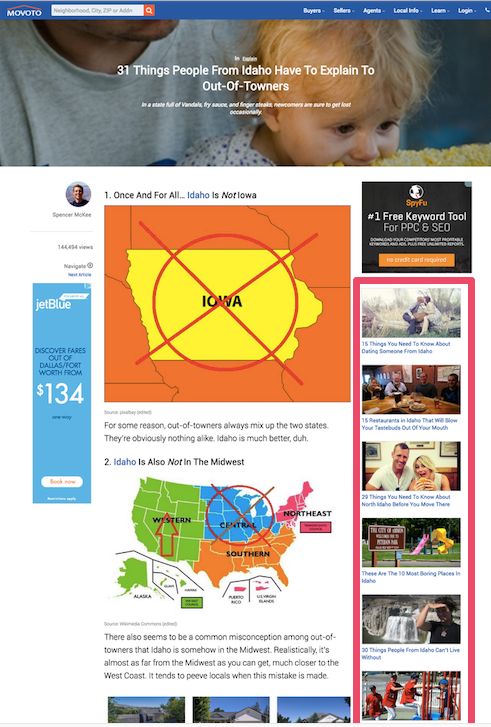
As an example, Ramsey uses Movoto, a service provides tools and information for the real estate, as a great example. You can see from the example below that localized pages they create go way beyond what we typically see for city-specific pages, as the content is compelling visually and topically, creating a rich experience visitors are likely to read, share, and link to.
5771190a4ad524.18699986.jpg

Adds Ramsey, "SMBs should ask every customer where they spend their time online. When they know that, they can start to create content that will appeal to them. The problem that most SMBs have is they get 'sold' on products that will update feeds with garbage or create content that doesn't really relate to their audience.

"Then they give up. I think they have to step back and realize that you can't outsource strategy. They need to be a part of it. They know their customer and need to be involved in determining how best to reach them."

  • What this tells us: Content quality goes beyond good grammar and solid images. Creating a content experience is the optimal goal.
  • How to make it for your brand: Focus on creating content that is uniquely better than anything you've seen or that could be easily created by the competition, no matter how large. Think of the elements that make your area unique and interesting, then work to create content that provides a sensory experience worthy of being talked about and shared.
  • Recommended reading/viewing: How to Create 10x Content - Whiteboard Friday

#2 — Relish the role of local expert

577122fc987348.22630443.jpg

Mary Bowling speaking at Mozcon Local

Each time I do a search for a local service provider and see a large national or regional brand show up, a little of the strategist in me dies insides. Yes, I get that larger brands have the deep pockets to spend on Google Adwords and the domain authority to wreak havoc in the organic search. But come on... A lot of small brands aren't even trying to compete, and that's a shame.

"Too often, with small brands, they think they'll have to hire someone else to create it," says Bowling. "They don't realize they are the local authorities, and simply writing what they know can go a long way. Most sales are taken at the location level, but small brands often don't do enough location-specific content to help their business. Often, with a simple phone call and a fifteen minute interview, we can create a post that's able to move the needle for their brand."

Bowling further added: "The goal for the content these small brands create is localized excellence."

Rob Robillard, aka A Concord Carpenter, provides an excellent example of how local brands can use the expert mantle to own their space. A general contractor, carpenter, and woodworker, Robillard has parlayed his expert and local knowledge into a correspondence gig for the Boston Globe.

577125abdcc1c5.81687128.jpg

Image courtesy of A Concord Carpenter

Says Rozek, "Robillard doesn’t write 'local' content as much as he’s a local business owner whose business has benefitted from his having become a noted local authority. Not only does he write for the Boston Globe, he also has a cable show" and a popular video series.

Also, stresses Rozek, different types of businesses will have different goals for their content.

A plumber, for example, is likely less concerned with having a piece of content that draws and engagement and get links; she needs the phone to ring. So having strong city-specific pages that have the ability to rank and get the phone to ring would likely be a more desirable option.

However, if a small brand can do both, they're better positioned to enjoy success.

"If you have a small site that has good authority and some good links, they're in the bully pulpit because any page they create is a little more likely to rank," says Rozek. "The name of the game, then, is to use the other pages of the site to help the city pages rank, since even if they are done well doesn't guarantee that they rank by themselves. But if you build links to other related pages on the site, those city pages are [likely to see a lift as well in organic reach], which is significant for building authority and engagement, even if the pages the links are pointing to don't get the phone to ring."

What this tells us: Don't focus solely on creating content that gets the phone to ring. Devote some resources to attaining links on other parts of the site.

How to make it for your brand: Spend time building your reputation as an expert of note in your area, then create and share content on your site and other sites you're able to partner with. Also, while city pages get people in the door, effective outreach can help you build links to other parts of the site that, in turn, provide a boost to the other pages on the site, including the city-specific pages.

Recommended reading: Top-3 Local SEO "Content” Wins for People Who Hate to Write

#3 — Get personal

One of the toughest sells to SMBs is getting them to see the value of making the content they share personal in nature. Makes zero sense when you consider that unique-to-only-you content is the one thing the competition cannot effectively copy.

"Small companies can create more unifying, educational, and insider content, but to do so they have to find the time and money to do it," says Ramsey, adding, if they do, "Small businesses can blow away competition."

577134f1d7f042.17074728.jpg

Mike Ramsey speaking at Mozcon Local

An impressive example of a small brand outpacing all comers is Danburry Barbershop in Provo, Utah. The site has a welcoming, old-school feel and contains images of customers before, during, and after they receive service.

5771462f8ab864.81545418.jpg

Danburry is getting right to the heart of personalized content by making local folks celebrities of sorts for, well, simply sitting in a chair and getting a trim or a wash. Let's be honest: Who doesn't want to show off their new 'do? You know the customers are sharing the experience with friends and family members while providing the barber shop with ready-made personalized content.

577146459102b9.02507011.jpg

Also, the brand posts images to social media, including Facebook and Twitter, creating a web of personalized content even large brands must envy.

"The Danburry Barbershop is killing it with a subdomain on a .blogspot site simply because he uses his site to showcase his customers," says Ramsey. "His Facebook feed is also filled with his customer stories and what they do. He is creating a loyal community of unified, educated, and insider Provo people."

My question to small business owners is, "What's stopping you from doing the same?" And for those who work with SMBs, either as strategists, SEOs, or content people, we mustn't shy away from making recommendations of this sort, especially when a brand has the bandwidth and the clientele to make it work.

What this tells us: Look for ways to get personal with your clientele, particularly as it regards the sharing of information involving them.

How to make it for your brand: Think of the people who've talked or written about how much they enjoy your product or service. Why not reach out to them for a quick interview, which could take the form of a short video that could posted to Instagram or YouTube or hosted directly on your site?

All you'd need is a few questions to ask them — don't make it about your brand. Make it about the audience: getting to know them, who they are, etc.

Recommended reading: The Power of the Personal: Personal Brands for Company Brands


Sign up for The Moz Top 10, a semimonthly mailer updating you on the top ten hottest pieces of SEO news, tips, and rad links uncovered by the Moz team. Think of it as your exclusive digest of stuff you don't have time to hunt down but want to read!


from Moz Blog http://ift.tt/29waJiB
via IFTTT

Wednesday, July 6, 2016

A 9-Part Client Management Manifesto Your Agency Should Steal

Posted by brianspatterson

It was my first day at my new gig as a federal government IT consultant in Washington, D.C. I was slogging through the typical onboarding paperwork when a senior partner dropped by, introduced himself, and handed me a paperback book.

“Read and implement this,” he said. The cover read The Trusted Advisor by David H. Maister, a book with a sole focus on “the ability to earn the trust and confidence of clients.”

“Client management must be important,” I thought.

This encounter occurred more than 10 years ago, in my previous profession. Before doing search marketing or SEO, I was a government IT consultant. I navigated bloated systems and untangled red tape. In the time I spent consulting at the FBI, ICE (U.S. Immigration and Customs Enforcement), and the CBP (U.S. Customs and Border Protection), I learned quite a few lessons that apply directly to the SEO industry.

The most important lessons I learned, perhaps, were about the art and science of effective client management. Many of those lessons learned have become standard operating procedure at Go Fish Digital. What follows is the codification of our client management approach. It isn’t a sexy new link building strategy or a mind-blowing algorithm update, but it's just as critical to the success of a project.

Overarching client management principles

To start, the following overarching principles help set team expectations. The three core areas that guide our client engagements are:

  1. Transparency: The majority of our tasks and communication take place in a project management tool (Basecamp) that the client has access to. We want them to see and participate in our discussions, questions, and decisions. By not having this process behind closed doors, we can always go back to when and why a decision was made within Basecamp.
  2. Continuous communication: We communicate at the pace the client prefers, but we err toward over-communicating. To a client, radio silence means no work is being done, even if that isn’t truly the case.
  3. Alignment: What are your client’s key performance indicators (KPIs)? What problems keep them up at night? We make sure to align our work and reporting with what is important to the client, rather than only pushing what we think is most important.

The following nine principles are built out of these three core areas, highlighting how you put these principles to work in day-to-day interactions with clients.

It should be noted that these aren’t hard and fast rules, but rather a philosophy to guide our team (and hopefully other agencies) on how to become trusted partners with your clients. It is hard to be perfect all the time (I sure as hell am not), but the more often these nine items are standard operating procedure, the better. So let's dive in, Star Wars-style.

1. Take the time to learn the industry

ll9jjQ8.jpg

I got the call from a team member to let me know a new referral had come our way. He was excited because it was a strong referral and very likely to become a client soon. I asked him about the project and what industry they were in. “Plastics machine manufacturing” was his response. Interesting... I knew next to nothing about that industry. Yet, we were very likely to have them as a client to help them market their products online. The first thing we needed to do was understand the industry, and we did this by diving in head first to learn everything we could about the plastics manufacturing lifecycle.

To make sure we have a solid foundation for a client’s niche, the team conducts a lot of discovery in the first month, such as:

  1. Reviewing the client’s website
  2. Identifying industry publications and blogs and reading them consistently
  3. Scheduling an in-person visit (if possible) to see how they work and meet the team
  4. Requesting any documentation they have about their products or services
  5. Watching online videos highlighting the industry, their products, and their team
  6. Building a lexicon document that includes jargon and definitions of words commonly used in their industry
  7. Purchasing and using the product or service ourselves (if reasonable and feasible)

As an SEO and marketing consultant, you will not be an expert in every client’s industry. But, it is important that you learn their space. This builds their confidence in you, helps you learn their language, and establishes trust.

2. Crush it on the kickoff call

ghReTMF.jpg

We were kicking off an online reputation management (ORM) project with a celebrity’s publicist and assistant. Prior to the call, we gathered everyone in the company that was a fan of this celeb and did a quick research session so we were all up to speed with his movies, causes, friends, and issues. For the kick-off call, we built a detailed agenda which contained specific topics and questions. The call left the client team feeling at ease that we understood the issue and how to fix it. As a team, we were pleased that all of our early legwork (and TMZ watching) paid off.

After the sales process, the project gets handed over to a client manager like myself. The first thing I do is get a kick-off call scheduled quickly with the client and anyone from their side who will be on the project. Since this is one of your earliest communications with the client, it sets the tone for the entire engagement, so you want to be organized and responsive in getting this meeting set up.

We include on the call anyone from our team who might touch the project. This way, they hear everything from the client at the start, and the client feels good because so many people are working hard on their project.

We always build an agenda for the kick-off call, and I make sure that there is at least one item that each person on our team can speak to. This allows each employee to demonstrate their expertise in the beginning and build a relationship with the client. If it's a phone call, the client may forget just how many people we have working on the account if only one or two people speak during the meeting.

3. Have open, visible tasks and team discussions

d3DvQ7V.jpg

We’ve been working with Amy for several years now, and she continually expresses her gratefulness for our transparency. Amy is a senior employee at a data security firm and is often traveling and working on other projects. By keeping track of every task on Basecamp and looping her into our work, she is able to quickly skim through completed tasks and see exactly where we stand on every project. She sees not only what we’ve accomplished in her absence, but also what’s on the horizon. Additionally, she can be directly emailed with any pertinent messages and chime in with a response to keep everything moving forward.

The goal here is to show everything except how the sausage is made. Why would you want to hide all of the time-consuming, difficult, and sometimes menial tasks you’re doing? Showing the client everything we are doing for them helps drive home the value of our service and keeps them from getting antsy about the occasional slow result.

The only place where we hold back a little is on drafts of deliverable reports. We keep those in our team Dropbox and simply reference the folder path when discussing them on Basecamp. We’ve found it keeps clients from getting hung up on things that we haven’t quite finished.

4. Respond within 24 hours

cjFT3xq.jpg

I was just breaking into online marketing when I heard something on the radio that caught my attention. My favorite show, The Sports Junkies in Washington, D.C., were looking to build a website for a new venture. They talked about how annoying it was to work with web designers because things always get difficult. In a moment of inspiration, I sent them a short pitch email that ended with, “Messages don’t sit around in my inbox. I respond immediately.” The next morning, someone from the show emailed me back, saying “I’m not sure why exactly, but I think I can work with you." I’ve worked closely with them ever since, and that relationship has helped springboard the Go Fish Digital brand in D.C.

From that original encounter on, I’ve always placed a high value on responsiveness. You know that person in your life who feels like you're late if you're on time? That’s how we are with this 24-hour response time rule. If you truly take 24 hours to acknowledge a client’s request, it may be within the time frame, but it isn’t honoring the spirit of the rule itself (37 pieces of flair, anyone?). It doesn’t take much to send a note saying, “We are on it”.

This is another area in which we err on the side of overdoing things. Even if the client sends an email that might not normally warrant a response, we still ping them back to let them know it was received.

One of the chief complaints about service-based companies is a lack of responsiveness. Counteract that by being committed to quick responses.

5. Be organized

Fi23z53.jpg

The director of marketing at a large financial organization likes to meet with our team weekly. We review the previous week’s progress and talk through our tasks for the next few days. This client is especially chatty, so without a formal agenda in place, there was the potential for the calls to devolve into a free-for-all, which would be inefficient for everyone. Because of situations like this, we always send a formal agenda ahead of time, which keeps us all on track and demonstrates to the client that we understand their goals and respect their time. Of course, we always allow our clients to ask questions or bring new things up. For the most part, though, we try to stick to the agenda.

Disorganization is frustrating. Sometimes you just have to deal with it. A spouse or child who misplaces everything, a friend who can’t remember an appointment, or a co-worker that never replies to important emails. While in these instances there is nothing you can do, a client who’s fed up with her vendor’s disorganization can simply get a new vendor. So we stress the importance of being ultra-organized on the project.

Have well thought-out agendas. Follow those up with meeting notes and action items if appropriate. Keep Basecamp organized with to-dos and messages. Communicate clearly. Always use calendar appointments. It’s the little things that show you are professional.

6. Be flexible and adaptable

xRluZx0.jpg

We work with a large car sales website that aggregates all car listings from across the web. When you're dealing with a site that has over 3 million pages, it's important to focus on optimization opportunities that scale. We identified site speed as one of these optimization opportunities. The site had been particularly laggy, and I was doing my best to get to the bottom of the issues with their CDN. Alas, I was stuck.

Fortunately, one of our other team members is Akamai certified and has configured CDNs for multiple large government websites. I looped him in; he started throwing around big words like “nodes” and “end points.” Some magic happened, I assume, and everything was fixed. The site was now blazing-fast and the client happy that his SEO team resolved an issue he didn’t even know they could help with.

No project is ever the same, which is great. How boring would it be if you applied the exact same strategy and principles to different projects, over and over?

We're always looking for ways to show additional value to the client. Whether it's by helping them with something out-of-scope or helping with deliverables that they have to pass on to senior management, there are always ways for us to contribute value. Although there's nothing wrong with up-selling, we don’t often like to say “that is out of scope” for a task that wouldn’t take us too long or be too difficult.

Additionally, we're very flexible in terms of how we work with a client. Is the client a phone person or email person? Are they hands-off, or intimately involved in the details? We try to get a good feel for this, and then adjust how we work with them based on their preferences.

7. Be in front of the technological curve, not behind it

8XSqlYl.jpg

Our new yacht charter client had just finished their first month with us and we were reviewing everything that had been done thus far. It was all very positive, and during the call, the CEO casually said, “I love the internal communication tool (Slack) so much that I’ve started using it at my other company.” Clients want to feel like you are doing things efficiently, effectively, and with the latest technology.

In our field, change is the norm. Every time Google launches an algorithm update, it can mean that a tactic that's worked for us for months or even years is suddenly obsolete. We’ve found that one of the best ways to avoid any surprises here is to stay ahead of the curve when it comes to strategies and tools.

I’ve mentioned our project management tool, Basecamp, a few times now. It may not have all the bells and whistles of others, but it’s dead simple to learn and our clients pick it up without any help from us.

We also use Slack both internally and with clients for brainstorming sessions. Slack provides quick access to the entire team, which is helpful for most of our day-to-day communication.

In addition to tools, we’ve found that everyone on the team needs to be comfortable with a core set of tech-savvy tasks:

  1. Reviewing and editing HTML and CSS
  2. Testing, installing, and configuring WordPress plugins
  3. Editing a WordPress theme
  4. Running ScreamingFrog against a site and reviewing the results
  5. Performing more advanced Excel functions like vLookups and pivot tables
  6. Examining a website’s DNS and understanding each element

Being tech-savvy in all areas of our business reinforces their trust that they are with the best team. Clients expect us to be tech-savvy, so we don’t want to let them down by looking like noobs.

8. Have an escalation path to turn to

zM4zb5N.jpg

While project work was underway for one of our financial sector clients, a reputation crisis popped up that went beyond our defined scope of work. We had worked with Google in the past to get certain defamatory web pages removed, but this particular case required some legal expertise. Luckily, we had a highly specialized ORM attorney in our network who was equipped to handle situations exactly like this. The client was grateful that we had a trusted expert on call and felt like their issue was being handled by an elite team that could deftly handle any issue that arose.

If things aren’t working, clients like when you have options to turn to. Bring in an expert from your team or even an outside consultant, but be sure to sell it as a unique offering or connection that you have. Being able to escalate situations to special people and processes when the initial solution doesn’t work keeps the project moving forward and prevents clients from seeking solutions from other agencies.

9. Show you care on a personal level

GSci7vM.jpg

Our client was having his first child, a baby girl. That is certainly a time to celebrate, so we made a nice card and sent it to his family along with an edible arrangement when his bundle of joy arrived. It went over great, both with the client and his wife.

I hesitate to call this a tactic, since caring should never be manipulative. Let's just call this a reminder to care. Small talk at the top of calls, for example, can go a long way in establishing a more personal connection than the robotic client/agency relationship. It's hard for introverts like me, but I force myself to do it because it gives the relationship more depth and meaning. At the end of the day, your reputation as a person is more important than building brands or making money.

Final thoughts

We do our best to instill these values in our organization and make it clear up front what our expectations are of every employee. Over time, these nine principles have evolved and will continue to do so as we work to continue building a good agency with a strong reputation.

Maintaining a positive relationship with the client is everything. Delivering on the results you sell and adhering to these nine principles will help both you and your client achieve success.

Do you disagree with any of these principles? Or are there others that are important to you, either as a provider or as a client? Let us know in the comments!


Sign up for The Moz Top 10, a semimonthly mailer updating you on the top ten hottest pieces of SEO news, tips, and rad links uncovered by the Moz team. Think of it as your exclusive digest of stuff you don't have time to hunt down but want to read!


from Moz Blog http://ift.tt/29vJx4W
via IFTTT

Tuesday, July 5, 2016

​The MozCon 2016 Community Speakers Have Landed!

Posted by EricaMcGillivray

[Estimated read time: 6 minutes]

That's right! Please join us in congratulating the four community speakers for MozCon 2016 — September 12–14 in Seattle.

This year, we received 140 submissions. And while the overall number of submissions were down, the quality of submissions has gone up. Typically, we've been able to eliminate ~100 submissions for not meeting the minimum bar, but this year, it was more like ~20. Which only means competition for these four slots was harder than ever before.

For those wondering more about what makes a great MozCon pitch, I've included the pitches, plus a comment from a committee member. (With a bit of the information redacted, because surprises on stage are good.)

Please congratulate...clapping hands


Alex SteinAlex Stein

SEO Manager at Wayfair
@sonofadiplomat

Alex Stein is currently SEO Manager at Wayfair.com, an online home goods store. Follow him on Twitter @sonofadiplomat for all things SEO, and he is, in fact, the son of a diplomat.

Alex's pitch:

Boost Rankings by Removing Internal Links

A majority of SEO advice covers gaining high volumes of external links, but many site owners fail to pursue the low-hanging fruit by reducing the number of internal links to drive organic rankings. Listeners will learn easy ways to massively optimize internal authority flow to boost rankings, with case studies to demonstrate these wins in action.

Business cases that will be covered:

  1. Slimming down your header navigation: Using [X] data and [X] to remove links from header navigation, while increasing conversion.
  2. Slimming down your footer navigation: I’ll cover how we used A/B testing to prove footer links weren’t driving qualified visits, just "tourist visits."
  3. For smaller sites, I’ll cover common mistakes with [X] that increase the total number of links on every single page.
  4. Reducing links on your most valuable pages: I’ll cover two concrete examples of how Wayfair reduced the number of links on product browse pages and drove additional visits.
  5. I’ll share a "Link Value Calculator"
  6. Lastly, I’ll also cover our formula for evaluating the dollar value of an internal link.

Felicia's notes: Sounds very actionable. I like the straightforward, traditional simplicity of the topic, and am intrigued by the "link value calculator"/"evaluating the dollar value of an internal link" ideas. If not a finalist, this would make a great blog post.


Emma StillEmma Still

Marketing Lead at Seer Interactive
@mmstll

Emma Still leads all marketing efforts for Seer Interactive. Prior to that, she led a team of SEO professionals at Seer, where she leveraged her digital marketing skills to recruit team members to build stronger, more successful digital teams.

Emma's pitch:

What if digital marketers thought about recruiting in the exact same way they thought about [smart] link building?

The highest commodity in our industry is human capital: the people on the teams, doing the work, getting. shit. done. Yet so many companies are desperate to find and recruit the talent they need.

The ironic thing is that the answer to their recruiting woes has been under their noses the whole time.

Using tools like [X] to find people who share content that aligns with your company’s mission or philosophy? Boom — list of candidate prospects.

All of those advanced search queries you’ve refined for identifying link prospects? You can easily use those for prospecting potential candidates. For example, [X query string]

Know someone who would be an ideal candidate but isn’t ready to make the leap to a new role? Use [X's] feature to find people they’re closely connected to and you’ve got a whole new set of prospects.

Digital marketers have all the tools and resources they need to find and recruit other talented digital marketers; all it requires is a change in perspective.

Christy's notes: Really interesting topic that tackles a pervasive problem in the marketing industry. Pitch is solid.


Robyn WinnerRobyn Winner

SEO Manager at Hornblower Cruises and Events
@robyn_winner

Robyn Winner is a passionate SEOer with a deep love for data analytics, user experience optimization, content strategy development, and her two adorable cats who fill her life with joy and fur...on everything.

Robyn's pitch:

I'd love to present on Navigation Optimization. It's a pretty meaty topic, and I could honestly talk for two hours on it, but in the 15 minutes I'd like to cover the key components that go into improving a site's navigation structure. These components include: Understanding the buying funnel for both B2B and B2C, utilizing [X] to provide a guideline to the navigation structure, stepping away from narcissistic menuing (i.e. [X]), incorporating calls to action, the basic elements all b2b and b2c navigations should have, and ensuring each page is its own unique URL! No more of this one-page website with anchor text.

I've worked with a lot of clients just on this, and each time we've seen massive success because what we inevitably do is improve UX by bringing relevant pages higher in the funnel. We then see improved ranks for those pages because they're naturally accessed more via the nav. Most importantly, we're able to identify gaps in content once we whiteboard the new navigation structure based on [X, X, and X] (which inevitably leads to more ranks!).

Ronell's notes: Highly relevant to EVERYONE.


Samuel ScottSamuel Scott

Director of Marketing and Communications at Logz.io
@samueljscott

Samuel Scott is a global marketing speaker and Director of Marketing and Communications for log analysis platform Logz.io, as well as a contributor to TechCrunch and Moz.

Samuel's pitch:

The 8 Things You Need to Check in Server Log Files in Technical SEO Audits

Server log files contain the only data that is 100% accurate in terms of how search engines crawl your website. Here's what to check and how to fix any related problems.

Crawl budget and volume. If the number of times that a search engine is visiting your site suddenly drops, check your [X], [X], and [X].

Response code errors. Every single server log entry contains a response code. Group URLs by response code to look into those problems easily and in bulk.

Temporary redirects. Every log entry with a 302 response code is a temporary redirect. Those should be changed to 301 (permanent) redirects.

Crawl priority. Which parts of your website get the most attention from search engines? Does that match [X]?

Last crawl date. If an update page is not appearing in the SERPs, check when Google last visited the page. Try submitting that URL directly in Google Search Console.

Crawl budget waste. [X]

Matt's notes: I like it. It's a source of data that I think intimidates a lot of folks, and I'd love to see it made accessible. If he can make it short and simple, I think it'd be good.


Thanks to everyone who tossed in their hat this year! It's a brave thing to even try.

Treat yo self!

Finally, I'd like to thank this year's community speaker selection committee – Chiaryn Miranda, Christy Correll, Felicia Crawford, James Daugherty, Matt Roney, Ronell Smith, and Sam Weber.

Cheer on community speakers and buy your MozCon ticket today!


Sign up for The Moz Top 10, a semimonthly mailer updating you on the top ten hottest pieces of SEO news, tips, and rad links uncovered by the Moz team. Think of it as your exclusive digest of stuff you don't have time to hunt down but want to read!


from Moz Blog http://ift.tt/29unf3M
via IFTTT

HTTPS Tops 30%: How Google Is Winning the Long War

Posted by Dr-Pete

[Estimated read time: 6 minutes]

It's been almost two years (August 2014) since Google announced that HTTPS was a ranking signal. Speculation ran rampant, as usual, with some suggesting there was little or no benefit to switching (and possibly significant risk) while others rushed to sell customers on making the HTTPS switch. Two years later, I believe the data speaks for itself — Google is fighting, and winning, a long war.

What's happened since?

If you only consider the impact of Google's original HTTPS update, I understand your skepticism. Prior to the update, our 10,000-keyword tracking system (think of it as a laboratory for studying Google searches) showed that roughly 7% of page-1 Google results used the "https:" protocol. A week after the update announcement, that number had increased only slightly, to just over 8%:

The blue/purple show the before/after based on the announcement date. As you can see, the update probably rolled out over the course of a few days. Even over a 2-week period, though, the impact appears to be fairly small. This led many of us to downplay Google's statements and ignore HTTPS for a while. The next graph is our wake-up call:

As of late June, our tracking data shows that 32.5% (almost one-third) of page-1 Google results now use the "https:" protocol. The tiny bump on the far left (above "A-14" = August 2014) is the original HTTPS algorithm update. The much larger bump in the middle is when Wikipedia switched to HTTPS. This goes to show the impact that one powerhouse can have on SERPs, but that's a story for another time.

What does it mean?

Has Google rolled out multiple updates, rewarding HTTPS (or punishing the lack of it)? Probably not. If this two-year trend was purely a result of algorithm updates, we would expect to see a series of jumps and new plateaus. Other than the Wikipedia change and two smaller bumps, the graph clearly shows a gradual progression.

It's possible that people are simply switching to HTTPS for their own reasons, but I strongly believe that this data suggests Google's PR campaign is working. They've successfully led search marketers and site owners to believe that HTTPS will be rewarded, and this has drastically sped up the shift. An algorithm update is risky and can cause collateral damage. Convincing us that change is for our own good is risk-free for Google. Again, Google is fighting the long war.

Is our data accurate?

Of course, our tracking set is just one sample of search data. The trendline is interesting, but it's possible that our keywords are overstating the prevalence of HTTPS results. I presented a number of roughly 30% at SMX Advanced in mid-June. Later that same day, Google's Gary Illyes called me out and confirmed that number:

Gary did not give an exact figure, but essentially gave a nod to the number, suggesting that we're in the general ballpark. A follow-up tweet confirms this interpretation:

This is as close to confirmation as we can reasonably expect, so let's assume we showed up to the right ballgame and our tickets aren't counterfeit.

Why does 30% matter?

Ok, so about one-third of results use HTTPS. Simple arithmetic says that two-thirds don't. Projecting the trend forward, we've got about a year and a half (16–17 months) before HTTPS hits 50%. So, is it time to panic? No, probably not, but here's the piece of the puzzle you may be missing.

Google has to strike a balance. If they reward sites with HTTPS (or dock sites without it) when very few sites are using it, then they risk a lot of collateral damage to good sites that just haven't made the switch. If, on the other hand, they wait until most sites have switched, a reward is moot. If 100% of sites are on HTTPS and they reward those sites (or dock the 0% without it), nothing happens. They also have to be careful not to set the reward too high, or sites might switch simply to game the system, but not too low, or no one will care. However I feel about Google on any given day, I acknowledge that their job isn't easy.

If rewarding HTTPS too heavily when adoption is low is risky and rewarding it when adoption is too high is pointless, then, naturally, the perfect time to strike is somewhere in the middle. At 30% adoption, we're starting to edge into that middle territory. When adoption hits something like 50–60%, I suspect it will make sense for Google to turn up the algorithmic volume on HTTPS.

At the same time, Google has to make sure that most of the major, trusted sites have switched. As of this writing, 4 of the top 5 sites in our tracking data are running on HTTPS (Wikipedia, Amazon, Facebook, and YouTube) with the only straggler being #5, Yelp. The top 5 sites in our tracking account for just over 12% of page-1 results, which is a big bit of real estate for only 5 sites.

Of the top 20 sites in our tracking data, only 7 have gone full HTTPS. That's 35%, which is pretty close to our overall numbers across all sites. If Google can convince most of those sites to switch, they'll have covered quite a bit of ground. Focusing on big players and convincing them to switch puts pressure on smaller sites.

In many ways, Google has already been successful. Even without a major, algorithmic HTTPS boost, sites continue to make the switch. As the number climbs, though, the odds of a larger boost increase. I suspect the war is going to be over sooner than the trendline suggests.

What are the risks?

Am I telling you to make the switch? No. While I think there are good reasons to move to HTTPS for some sites and I think most of Google's motives are sincere on this subject, I also believe Google has been irresponsible about downplaying the risks.

Any major change to sitewide URLs is risky, especially for large sites. If you weigh the time, money, and risk of the switch against what is still a small algorithmic boost, I think it's a tough sell in many cases. These risks are not theoretical — back in May, Wired.com wrote up the many problems they've encountered during their HTTPS switch, a switch that they've since paused to reconsider.

Like any major, sitewide change, you have to consider the broader business case, costs, and benefits. I suspect that pressure from Google will increase, especially as adoption increases, and that we're within a year of a tipping point where half of page-1 results will be running on HTTPS. Be aware of how the adoption rate is moving in your own industry and be alert, because I suspect we could see another HTTPS algorithm update in the next 6–12 months.


Sign up for The Moz Top 10, a semimonthly mailer updating you on the top ten hottest pieces of SEO news, tips, and rad links uncovered by the Moz team. Think of it as your exclusive digest of stuff you don't have time to hunt down but want to read!


from Moz Blog http://ift.tt/29K3ml8
via IFTTT

Friday, July 1, 2016

The Best On-Page SEO Tool in the Business Now Has Unlimited Access via MozBar

Posted by Roxana_Nelson

[Estimated read time: 4 minutes]

This is going to be an exciting year for MozBar. I’m happy to announce that we’ve got something new that will help you save a ton of time tuning your on-page SEO.

(New to MozBar? Learn more about our free SEO toolbar extension available in the Chrome store.)

We've added Page Optimization to MozBar Premium!

If you want to dive right in, download MozBar for Chrome. To access the Page Optimization feature, you'll need to be logged in to your Moz Pro account. If you don’t have a Moz Pro account, you can take a free 30-Day trial to check out all the new goodies.

Currently in Moz Pro, you can run a Page Optimization report for any of your tracked keywords and campaigns to get detailed information on how to optimize your page for a keyword, and where you're getting things right.

MozBar_Blog_Screenshot_MKTG_1529.jpg

We’ve taken this functionality and put it in the MozBar — except now you can check on-page optimization for ANY keyword on ANY page, not just ones you're tracking. It’s like having Moz Pro on-the-go. As always, the keywords and pages you research via MozBar are limitless — that’s right, they won’t affect any of your limits in Moz Pro.

MozBar_Large.gif

You now have the flexibility to check any keyword on any page. This opens the door to tons of new ideas for page optimization, paving the way for you to rank higher in the SERPs. Quickly check any page on your site for keywords you're tracking and see how optimized (or not) your page is for target keywords, in real time. You’ll also get detailed suggestions on how to optimize your page. This can help you decide whether or not a keyword is worth optimizing for, or maybe you’ll find you’re already doing a great job and can move on to the next one.

Optimizing your page using MozBar

I’m always on the lookout for an article with good parenting tips, especially when it comes to traveling with children. I like the Honestly blog by the Honest Company, so let’s use this post about flying with kids as an example of how to optimize your page using MozBar.

Let’s say I’m targeting the keyword “flying with kids” and want to see how well this page is optimized. I chose this keyword because it feels like a query that can be answered by the content well, and after researching it in Keyword Explorer, I found that it has good search volume and a good Potential score.

1. First, we’ll open MozBar on the page. We’ll click on the new Page Optimization icon next to the Highlight tool.

2. Then, we’ll type in “flying with kids” in the text field. Click on “Get Score.”

3. Looking good! This page has a Page Optimization Score of 94 out of 100, which is great. There are three suggestions for improving this score even more, such as adjusting keyword placement in the page title and using targeted keywords in the H1 headers periodically on the page.

Overall, a pretty well-optimized page!

Here are some other ways to use Page Optimization in MozBar:

  • Review competitors’ pages: Another benefit of being able to check any keyword + page URL combo is that you can see how well your competitors are optimizing for certain keywords, too. This insight could help you learn which keywords your competitors optimize for and how.
  • Improve client proposals: Prospecting for potential clients has gotten easier, too. Now you can audit a prospect’s pages and find opportunities for on-page optimization improvement — a valuable resource for any SEO putting together a site report for a potential client.

How it works

For each keyword + page URL combo you check, you’ll get a Page Optimization Score, just like in the campaign-based version of Page Optimization in Moz Pro. The Page Optimization Score is a metric we use to gauge how optimized a page is for the keyword you’ve paired it with.

  • We take twenty-seven contributing factors to a well-optimized page and score your page for that particular keyword.
  • We’ve broken down your score by Suggestions (items you may want to tweak or optimize) and Solved (a list of factors that are positively influencing your score).
  • You’ll get the full list of both Suggestions and Solved factors that contribute to your score under the All Factors tab.
  • We also highlight the highest-priority items under Most Important Fixes. If you need more insight, expand the suggestion and you’ll get real advice from one of our SEO experts.

What’s coming next?

And we’ve got another cool feature on the horizon. We’ll be adding Related Topics to MozBar very soon. In addition to all the data you get from Page Optimization, Related Topics will surface a list of popular topics that your audience may be in interested in based on other topics that appear in the SERP. You’ll also see the pages that talk about those topics. Pretty sweet!

Check it out!

You can start using Page Optimization in MozBar Premium today with your Moz Pro subscription, or try it free for 30 days. Also, starting today, you’ll need to be logged in with either your Community account or your Moz Pro account to access link metrics. Read more about it here in my Q&A post.

Enough talk — I want to download MozBar!

Give Page Optimization for MozBar Premium a spin today, and as always, we’d love to hear what you think of it!


Sign up for The Moz Top 10, a semimonthly mailer updating you on the top ten hottest pieces of SEO news, tips, and rad links uncovered by the Moz team. Think of it as your exclusive digest of stuff you don't have time to hunt down but want to read!


from Moz Blog http://ift.tt/298pc0A
via IFTTT

How to Tie Marketing Metrics to the Data that Boards, CxOs, and Investors Really Care About - Whiteboard Friday

Posted by randfish

SEOs and executives speak different languages. It's a simple fact, but it's one that often acts as a blocker for getting your ideas and investments approved. A simple change in how you communicate your marketing goals, triumphs, and challenges could be what's standing between you and getting the C-suite buy-in that's integral to your success. In today's Whiteboard Friday, Rand helps you translate your marketing jargon into financial metrics and data that the folks in charge will actually care about.

How to Tie Marketing Metrics to the Data that Boards, CXOs, and investors really care about whiteboard

Click on the whiteboard image above to open a high resolution version in a new tab!

Video Transcription

Howdy, Moz fans, and welcome to another edition of Whiteboard Friday. This week we're going to chat about tying marketing metrics that marketers use to the things that CEOs, CXOs, whatever the C-level titles that you've got are, investors, board members, to the metrics and data that they care about.

This is a problem that I've talked about with many marketers over the last few weeks, especially at some conferences and events where folks say, "Hey, we've got our metrics dialed in. We know what we're doing. But when we present it to the Board, or when we present it to our CMO, or our CEO, when we show it to our investors, not only do they not get it, it's like we're not speaking the same language, and therefore we're not able to have a conversation productively about where investment should and shouldn't be made, and they're not able to give input into whether they think our idea is a good one, or whether they think there's a good return on investment there." This can be tough.

Start with the metrics that marketers care about

So what happens is you're a marketer, you're presenting here to your Board of Directors or to your executive team, and you say, "Hey look, we've got traffic growing in every category. SEO is up. Social is up. We've grown our link profile, which is going to help us with search, all these great things." Fantastic, but the Board is sort of sitting there like, "Well, I don't really know how to contribute, and how does that tie in to higher lifetime value of customers, because that's the thing that I know and the thing that I care about, and I'm not sure this marketer person is really investing in the right kind of ways for the organization."

That sucks. As a marketer, that totally sucks, because it means that you are not communicating your message, and that means you're not going to get, you're unlikely to get buy-in from all these people that you really care about and need their permission and their acceptance in order to make the investments you need.

The thing is, marketers are very focused on the funnel.

We care about metrics that show top-of-funnel growth. We care about which channels send that top-of-funnel traffic. We care about how people are moving through the funnel. We want to see conversions and conversion rate, which is why we work so much on conversion rate optimization, and we care about marketing metrics that predict better retention or greater recidivism, meaning people are buying again or coming back and becoming customers again.

This is our world and we live in it. It does translate okay, decently to the Board level.

Translate marketing metrics to the financial ones that investors care about

But if you think about what folks care about at the highest levels of a company's strategic imperatives — that could be a Board of Directors, could be investors, could be C-level folks — they're really focused on things like market size, meaning: How big is our addressable market? Who could we potentially reach? What if we run out of those people — can we keep growing? Are more of them coming into the fold, or are people exiting this market and going somewhere else?

They care about cost of customer acquisition. How much does it cost us to get one new customer?

They care about customer revenue, the revenue that we actually get from those customers that we're bringing in, whether that's going up, and overall growth rate. Are we getting more customers over time? Is that rate of growth expanding, meaning acceleration?

They care about customer lifetime value. Customer lifetime value is something that pretty much every metric we calculate as marketers should tie back to that, especially when we're having conversations with these kinds of people. Essentially it is when a new customer comes in and they make any kind of purchase from us, they spend any type of dollars with us — a product, a service, a subscription, whatever it is — how much do we get over their customer lifetime? Meaning if it's an e-commerce play, it could be the case that they come and they buy five things from us over the course of two years on average, and that dollar total is $360, and 40% of that is gross margin for us. Essentially, the rest is cost of goods. Okay, that's customer lifetime value.

Or if you have a subscription business, like Moz is a subscription business, if you subscribe to our tools, we'll charge you $99 a month or $149 a month. I think on average our customer lifetime value is essentially $120 times the average customer lifetime span, which is somewhere around 11 months all in. So it's that number multiplied out. So $1200 or $1300, somewhere around there, that's customer lifetime value.

That doesn't actually count recidivism, people who quit and then come back again. We're trying to get to that metric, and we need it, because you want to be able to speak to true customer lifetime value. This is sort of the underpinning of all the rest of this.

But other things these folks are going to care about, comparison of cohorts. So it's not the case that all customers are exactly the same. You know this as a marketer, because you know that it costs you a different amount of money to acquire folks through one channel, and they perform differently than folks who are acquired through a different channel. You know that different cohorts of personas, for example, people let's say who work in an agency versus who work in-house, maybe those are two different kinds of people that you serve in a B2B model. Or you know that folks who are higher income versus lower income spend different amounts at your e-commerce shop, that type of stuff. That comparison is very interesting to these folks as well.

Another comparison that matters is a competitive comparison. How big are we, how big are they? How fast are they growing, how fast are we growing? What's their customer lifetime value, what's ours? What's their retention and recidivism rate, what's ours? Those things, massively interesting to this group as well.

Then there's a bunch of other stuff that they care about, like cost of goods and teams and market dynamics, etc. Marketers generally don't touch that stuff and don't usually need to worry about it.

But the solution to our problem here is to speak this language.

So let's go back to our initial story.

Instead of saying, "Here's traffic growth from all these different channels, and here's how we're investing in search, versus social, versus paid ads, versus trade shows," all this kind of stuff, what we want to say is something like, "Hey, here's the traffic from SEO, and here's the traffic from social, and as those have been growing, our cost to acquire a new customer has been falling, because those channels are organic, and that means we don't pay each time we get a new customer from them. We only pay for the upfront investment in sweat equity, creativity, engineering needs, web engineering needs, and whatever we're doing. But then it keeps paying dividends, and because of that you can see this CAC falling as our search traffic has risen."

Now you have the attention of these folks. Now you've engaged them in a way that they care about, because they say, "Aha, more organic search, lower cost to acquire a customer," — which is great because CLTV to CAC ratio, the ratio of lifetime value to acquisition cost, this ratio right here, is something that every investor, every Board of Directors member, every CXO cares deeply about. It's the underpinnings of the company. That's what makes a profitable company work and what gives it the ability to grow. When you speak their language, you get this type of response.

So what I'm going to urge you to do as a marketer is to take any metric, any data point, any story you're trying to tell around return on investment, around a project you have, and turn it into something that makes sense to the group of people that you're talking to, especially if that's strategic-level. You want to tie those to tangible improvements or to issues. It could be problems. It may not be just positive things. It could be negative things too, in the areas your CXO or Board or investor cares about.

So let's imagine — and this is a conversation that many, many folks have — they say to me, "Rand, we want to hire an SEO consultant, or we want to bring an SEO in-house full-time, but we've been having trouble getting buy-off from our CEO or our CMO or our Board."

Well, let's change the conversation. Instead of, "We need to hire an SEO consultant because SEO is really important, search engines send a lot of traffic, and search traffic is something we're not competing in well right now," to, "CAC is high. CAC is too high. Our cost to acquire a new customer right now is too high, and our CLTV is too low for customers that we buy via paid search. So we're spending a lot of money on paid ads right now, and the customers we get via that have this high customer acquisition cost, because we have to spend money to get them, and the CLTV isn't as high because customers who come through paid, on average, usually tend to underperform compared to those who come through organic. It's just a fact of who clicks on ads versus who clicks on organic results. But, if we ranked organically for more of these keywords, and we could get more SEO traffic compared to our PPC traffic, we could stop (a) losing those searches to our competitors, who are outranking us now, and (b) we would bump up the CLTV and we'd be lowering cost of customer acquisition."

Boom. You have changed the conversation to something that this group of folks really gets, and you've made it much more likely that they are going to say yes to your proposal.

Same thing here. Let's say you say, "Hey, we're going to do something crazy. We want to actually spend more on trade shows, on events, on speaking, on going places physically in-person. It's expensive. We don't reach as many people as we do over web channels or over traditional ad channels, but we've been getting good customers via events."

That's a real tough sell unless you do this. "Dear Board, here's a comparison of customers acquired via our five major marketing channels. Here's SEO, here's PPC, here's our Facebook ads, here's organic social, and this is events. You can see cost to acquire, you can see lifetime value, you can see the ratio, and you can see the numbers of folks that we've gotten via each of those channels and the revenue they bring in."

Awesome. Now, repeat buyers and referrals are so much stronger from events, from this group over here, that even though it costs much more, the math works out that it is the best investment we can make over the next couple of quarters. We want to bring this up by two or threefold, and if we keep seeing continued investment or continued metrics in the same way we have the last few months, we're going to have the highest positive ROI from that investment versus any of these other channels.

Awesome. Change the conversation, made it something these folks understand. Speak their language, and you get the buy-in you want.

All right, everyone, look forward to your comments and thoughts, and we'll see you again next week for another edition of Whiteboard Friday. Take care.

Video transcription by Speechpad.com


Sign up for The Moz Top 10, a semimonthly mailer updating you on the top ten hottest pieces of SEO news, tips, and rad links uncovered by the Moz team. Think of it as your exclusive digest of stuff you don't have time to hunt down but want to read!


from Moz Blog http://ift.tt/299DW11
via IFTTT